
In Conversation with
Mia Ponzi Hamacher
The Wandering Goose
welcomes
Mia Ponzi Hamacher
There are some people who come through Tokeland and it stays with them, not just as a place, but as a feeling.
Mia is one of those people.
When she returns this May to cook with us, it feels less like a visit and more like a continuation of that connection. Ahead of her dinner, I asked Mia a few questions about what shapes her cooking, from family and leadership to art, place and the way the coast shifts how you think about food.
Please join us on May 17 for an intimate evening with Mia Ponzi Hamacher.
Heather ~
I’m thinking of Mother’s Day coming up. How has your mother or grandmother influenced the way you cook?
I learned to cook from my entire family. Everyone cooks. As a kid, my dad was the family chef and made delicious, beautiful, sit-down dinners for my three brothers and me almost every night. Still, it’s my grandmother who taught me to love cooking. I come from a big family, so one-on-one time is rare and precious. When I was young, I wanted nothing more than time with my grandmother. When her house was full of my cousins, uncles, and aunts for Sunday dinners and special occasions, she would always be in the kitchen—so I was, too. I learned to cook by her side; she taught me to peel potatoes with a knife, to clean squid under cool water, to store freshly washed lettuce in a clean pillowcase, and harvest tomatoes from her garden in a big dented colander. The kitchen with her was a sacred place, and it was a special status to be allowed in and given a job, I felt so special. She played music while she cooked with the windows open and a glass of sparkling wine nearby. Cooking with her was beautiful and imaginative, with a rhythm and cadence that came so naturally. She made feeding people seem like the most glamorous job you could possibly have. Of course, I wanted to cook!
What has your experience as a woman in professional kitchens taught you about leadership and resilience?
I used to feel like I had something to prove, probably because I did, to myself! I was often the only woman and almost always the youngest in the kitchen. I was constantly underestimated for both reasons, even many years into my career my competency was never assumed. At a certain point, my perspective changed. I worked with a couple of women I looked up to who led with such a subtle, generous confidence. They had nothing to prove; their skills were polished, their technique was elite, and their creativity was undeniable. They cooked delicious food at a high level without the ego that is so commonplace for male chefs. Instead of militancy and hierarchy, these kitchens I adored were built from a desire to teach and a constant openness to learn. I realized I didn’t want to be anything like these macho chefs I had looked up to—I wanted to be humble and curious like the women I worked for and alongside, and so deeply admired.
You described Tokeland as something you return to in your mind. What does it give you that feels hard to find elsewhere?
I love old stuff, when there’s history and life and time in a thing or a place, it has this very special feel that can’t be faked. Tokeland has that. It feels rich with existence and the grit of perseverance. It’s cozy and charming, and it’s very own self, made up of the hard work of so many people. I love to be in a place full of such feeling!
You’ve cooked in New York and now in wine country. How does cooking here on the coast shift your perspective?
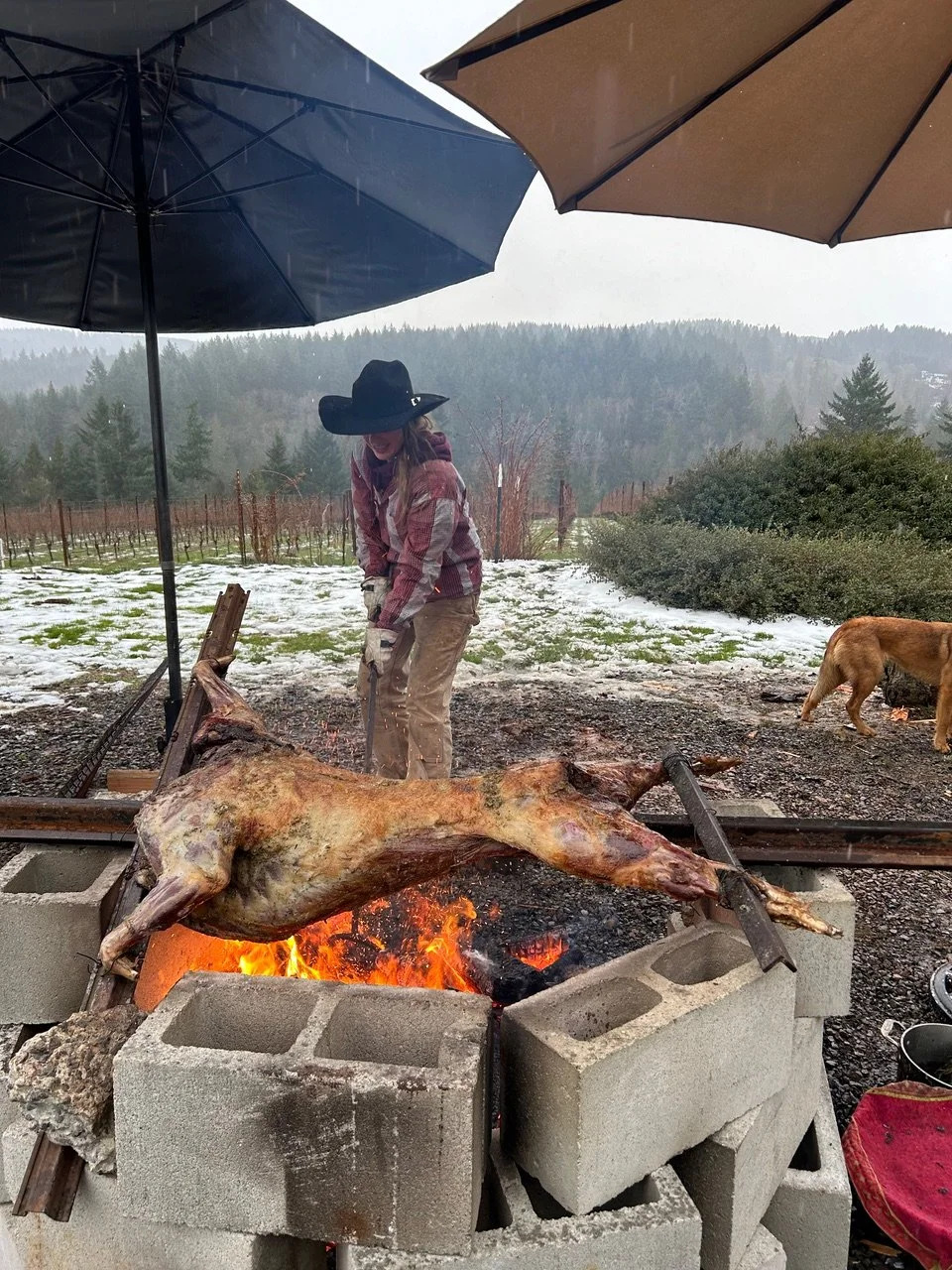
In New York, we were building menus with such a consumer-focused approach that we lost sight of the things I love about cooking. I like to make delicious food and to feed people, but I also like to make food that makes sense. Food that is tied to a place and a time. Seasonal and local are buzzwords in a big city like New York, but when you know the person catching the fish, and you harvest the produce from your own plantings, these words actually mean something. Just because people want peas for spring doesn’t mean the peas are ready on April 1; the peas might not be here for a few weeks, and that’s okay! I love to cook with such honesty, to only serve the thing when the thing is beautiful and ripe, and then to have to wait a whole year to serve it again. I think the food is better. I think the people eating it get something more genuine on their plate because it’s not just meant for them; it’s meant for them, here, now.
What role does art play in your cooking, and how does it show up on the plate?
I studied sculpture in New York and people always ask me some version of “do you still make art”. I feel like I was making art the whole time and never stopped. From restaurant work to school back to restaurant work and now cooking at the inn. I had a hard time working with metal, wood, and ceramic because I would love to make the thing, but then it would just sit. The purpose felt sort of empty to me. I love food because I get to make the thing full of all that creative energy and effort and then the thing gets to be consumed and serve another purpose as nourishment. It’s not a piece of art like on the wall, instead it's a piece of art on the plate, and then this whole other creative endeavor is the exchange of the thing I create and the person who eats it— to me it’s all an art.
What ingredient are you most excited about right now?
Yesterday I thinned the green garlic I planted last fall at my friend's farm, and it felt so special to cook with that. I had gone foraging on Monday and found some morels, so I stuffed them with pork (also from the farm) and that green garlic. I tempura-fried them very simply, and my girlfriend and I ate them there, impatiently, standing beside the stove while they were still too hot to touch, burning our mouths and fingers with eagerness. It was a perfect meal. I love the spring because it comes along gradually in the Northwest. You get these teases of sun and rain and slowly nettles, pea shoots, greens— life returns to the kitchen. I love the feeling of the earth coming back for another season, and all the patience it requires as a cook not to get ahead of it all, but to just gradually enjoy each new gift. Summer comes on quickly, but spring is more delicate.
Mia Ponzi Hamacher
Co-owner | Innkeeper | Chef
Sosta House